
Where Can a Kenyan Passport Take You Visa-Free?
There’s a specific kind of conversation that happens whenever passport rankings make the news — someone shares the latest Henley Index, someone else screenshots Kenya’s position relative to Singapore or Japan, and the group chat settles into a familiar mood: resigned, a little defeated, the sense that a Kenyan passport is something you travel despite, not with. It’s an understandable reaction. It’s also based on looking at the wrong number.
Rankings measure a passport against every other passport on Earth, which is a strange way to answer a much more useful question: where can you, specifically, actually go, right now, without sitting in a visa queue first? Answer that one and the picture changes. A Kenyan passport currently opens close to seventy countries and territories without a pre-arranged visa — not a small number, and not the countries you’d guess first. The real story here isn’t the rank. It’s the map, and one uncomfortable fact about who’s actually reciprocating.
The unlikely places
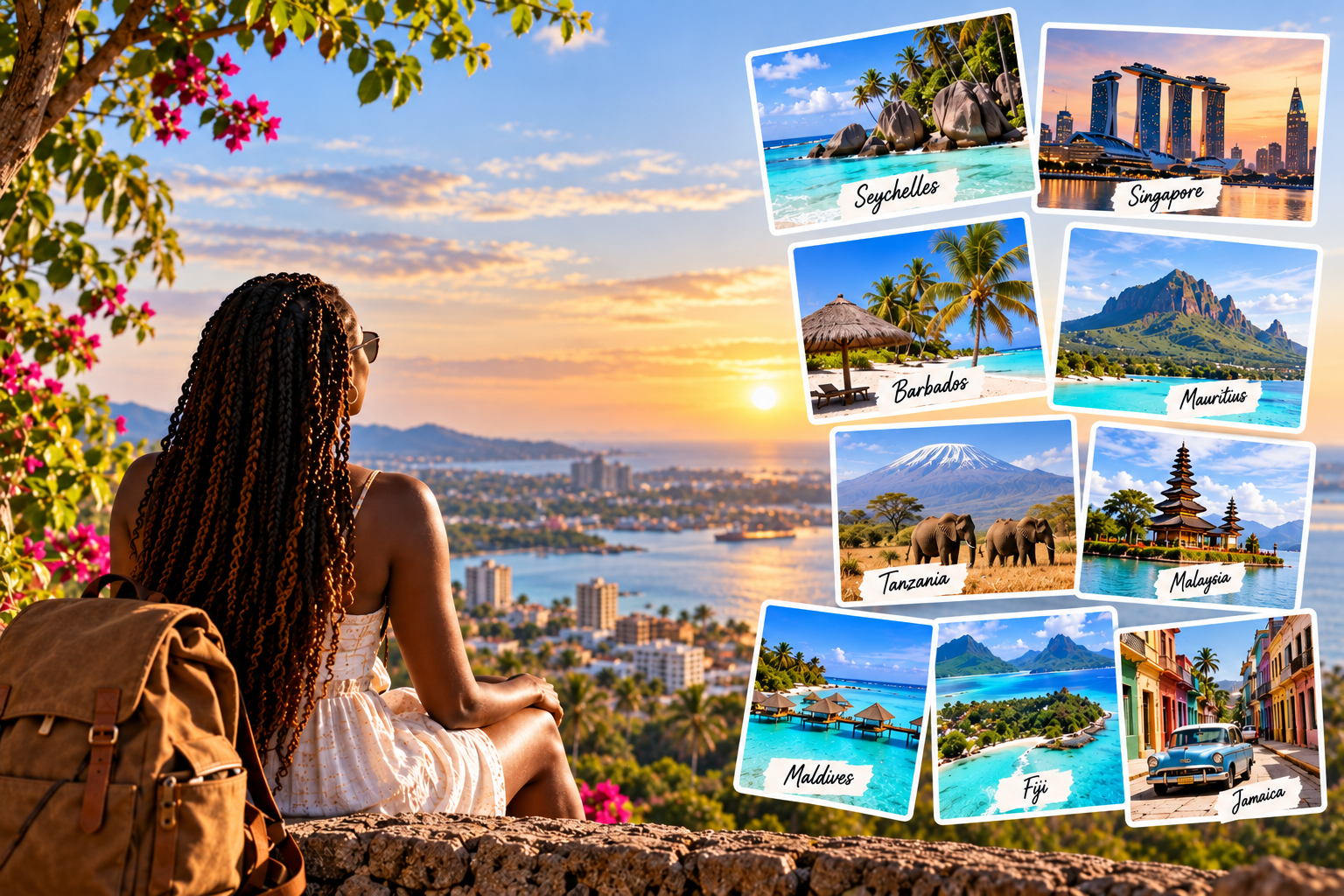
Start with what surprises people most: the Caribbean is unusually open to a Kenyan passport. Barbados, Jamaica, the Bahamas, Trinidad and Tobago, Antigua and Barbuda, Grenada, Dominica — all visa-free, some for stays as long as six months. None of these are budget destinations exactly, but the point isn’t the price of the flight. It’s that a huge stretch of the Caribbean has effectively no immigration friction at all for a Kenyan traveller, at a time when a lot of people assume the opposite is true everywhere outside Africa.
The Pacific tells a similar story on a smaller scale. Fiji, Vanuatu, Kiribati, Micronesia — all open, no visa required, no application to file weeks in advance. It’s an odd cluster to picture from Nairobi, admittedly; nobody’s booking a long weekend in Micronesia. But it says something about how passport access actually gets negotiated, country by country, often based on colonial-era travel agreements and Commonwealth ties rather than anything current bureaucrats sat down and designed — which is exactly why the map doesn’t follow the logic you’d expect it to.
The neighbourhood, properly covered
Closer to home, the access is dense enough that it’s easy to take for granted. Uganda, Rwanda, Tanzania, Zambia, Zimbabwe, Botswana, Namibia, Malawi, Mozambique, South Africa, Eswatini — all visa-free, most for 90 days. Ethiopia currently allows a full year. This is the part of the map most Kenyans already use without thinking about it as a “visa-free” benefit at all; it’s just how a Kampala weekend or a Cape Town trip has always worked.
One genuinely useful detail buried in here: the East Africa Tourist Visa lets a single application cover Kenya, Uganda, and Rwanda together — one $100 fee, 90 days, multiple entries between all three, instead of paying for three separate visas at a higher combined cost. Tanzania sits outside that particular arrangement, which catches people out when they assume “East Africa” means all four. If a trip is genuinely regional — Kigali for a few days, then Kampala, then home — that single visa is the detail that makes it worth planning as one trip instead of three.
The Indian Ocean, without the paperwork
For the honeymoon-and-wellness crowd specifically, this matters more than the Henley rank ever will: Mauritius is fully visa-free for Kenyan passport holders, and Seychelles issues a visitor permit on arrival rather than requiring anything pre-approved, both for stays generous enough to justify the flight. The Maldives adds a free 30-day visa on arrival to that list. Three of the destinations that show up constantly in “dream trip” conversations across Nairobi are, practically speaking, no harder to book than a domestic flight once the ticket’s paid for.
Asia’s quiet exceptions
Asia is where a Kenyan passport’s access gets genuinely selective, which makes the exceptions worth knowing precisely because they’re exceptions. Singapore and Hong Kong are both visa-free — proper global hubs, not consolation destinations, and both frequently cheaper to fly into from Nairobi than people expect given how far they sit on a map. The Philippines and Malaysia add 30 days visa-free each. Put a Nairobi–Singapore–Bali routing together and there’s a genuinely well-connected Southeast Asia trip available with a single visa-free anchor point and short regional hops from there.
The gap nobody puts on the infographic
Here’s the part of this story that the usual visa-free listicles skip entirely, and it’s the most important thing in this piece: in July 2025, Kenya opened its own border to nearly every African passport holder, replacing its earlier paid electronic travel authorisation with straightforward entry on a valid passport alone. It was a genuinely significant, generous policy shift — Kenya deciding, unilaterally, that continental mobility mattered enough to go first.
The favour has not been returned in kind. Kenyans still need a visa to enter roughly twenty African countries, including Nigeria, Egypt, Morocco, Tunisia, Cameroon, Côte d’Ivoire, Ghana’s neighbour Benin, and Angola, among others — a mix that spans West, Central, and North Africa. Kenya’s Prime Cabinet Secretary said, on the record, that the government “hopes the rest of the countries will reciprocate.” The African Union’s own Protocol on Free Movement of Persons — the framework meant to make exactly this kind of continent-wide access standard — has been signed by 32 countries but ratified by only four, far short of the fifteen needed to actually take effect.
It’s worth sitting with what that means practically: a Kenyan passport currently has smoother, less bureaucratic access to Barbados than it does to Lagos or Cairo. That’s not a comment on Kenya’s diplomacy so much as a genuinely useful thing to know before assuming “it’s Africa, it’ll be easy” and skipping the visa research entirely. Passport power, it turns out, isn’t really about how strong your country’s document is in the abstract. It’s a running tally of bilateral decisions, and Kenya’s government has just made a much bigger one-sided bet on openness than most of its neighbours have matched.
What to actually do with this
None of this list is static, which is exactly why it’s worth checking against the current official requirement before booking rather than trusting a screenshot from a few months ago — Henley’s own numbers moved measurably in the last year alone, and bilateral agreements shift with surprisingly little warning. “Visa-free” also isn’t the same as “no questions asked”: immigration officers everywhere still expect a return ticket, evidence of funds, and somewhere to stay, visa or not, and turning up without those is still the fastest way to have a short, unpleasant conversation at a border desk regardless of what the visa policy technically allows.
But the broader point stands, and it’s the one worth carrying out of this piece: the instinct to treat a Kenyan passport as something that mostly closes doors undersells it. It opens a genuinely wide, genuinely varied stretch of the world — Caribbean islands, Pacific nations, most of Southern Africa, two of Asia’s biggest hubs, and the Indian Ocean escapes everyone already wants to go to. The map is bigger than the rank suggests. It’s just worth knowing which twenty countries on your own continent didn’t get the memo yet.